In this article
Distinguish event time, delivery time, and the current record when interpreting payment notifications.
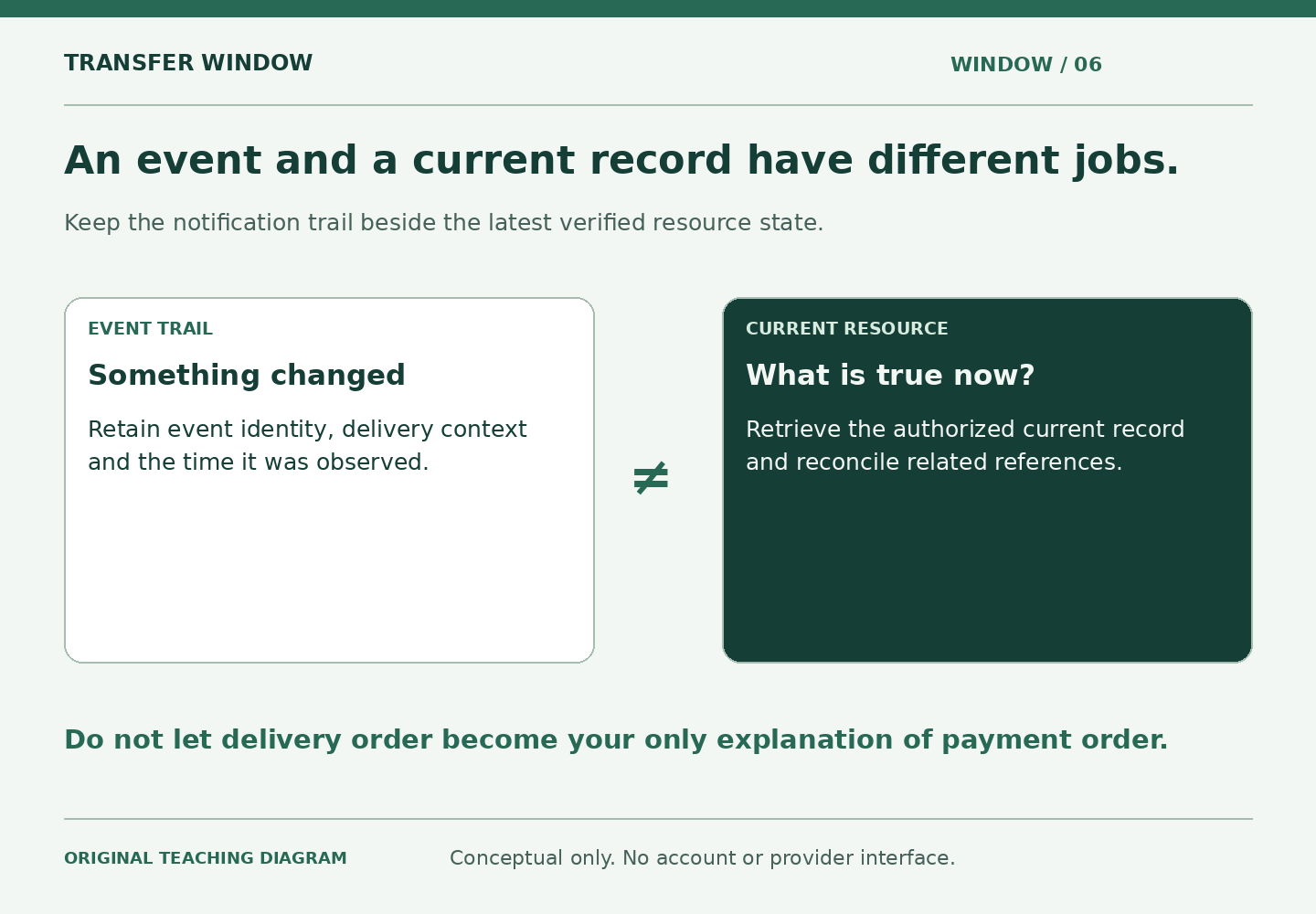
Software notifications can make a payment history look more precise than it is. Each message has a timestamp and a technical label, which encourages readers to arrange everything in arrival order and treat the resulting list as the story. A better approach distinguishes the underlying event, the message carrying it, and the current record being discussed. This article is a conceptual guide for operations and product readers, not an integration implementation or a diagnosis of a live system.
Understand what a webhook contributes
Dwolla’s Working with Webhooks guide describes event notifications associated with resources. It states that delivery is asynchronous, ordering is not guaranteed, and applications should protect against duplicate events. Those qualifications matter when interpreting a list of notifications as evidence of payment progress.
A message can tell you that an event was reported. It does not eliminate the need to identify the related record or understand the event’s scope. The event may concern a customer, a funding source, or a transfer rather than the entire commercial obligation someone is tracking. Technical detail is useful only when attached to the right question.
Keep three times separate
A useful event worksheet has space for the event time supplied, the time the notification was received, and the time the current record was checked. These timestamps describe different observations. If only one is available, label it honestly instead of copying it into the other fields.
Imagine a fictional operations team receiving two messages several minutes apart. The later-arriving message carries an earlier event time. Sorting by inbox order tells the story of delivery; sorting by supplied event time tells a different story. Neither alone establishes the complete current state. The team should preserve both views rather than forcing one timestamp to serve every purpose.
Count identities rather than messages
Two messages do not necessarily mean two payments. Before counting a notification as another movement, identify the event and resource it concerns. An event identifier and a payment reference answer different matching questions, and neither should be replaced with the amount simply because the amount is easy to read.
An independent review worksheet can mark each row as a distinct identified event, a possible repeat, or an unresolved match. These are review categories rather than provider statuses. They make the reviewer’s confidence visible and keep duplicate-looking material from being silently discarded or incorrectly added to a payment total.
Separate history from current state
A history explains what has been reported over time. A current-state view answers what the relevant record shows at a particular observation time. Both are useful, but they should not be forced into one field. A historical notification can remain valid evidence even after a later observation supplies a different state.
For a fictional example, a support analyst receives an older creation-related message after reviewing a newer status record. The arrival of the older message should not automatically make the analyst describe the payment as newly created again. The record identities and timestamps need to be reconciled. The important discipline is to avoid letting delivery order silently override a more relevant observation.
Treat quiet periods as questions
An absence of new messages can have several explanations, and the notification list alone may not establish which one applies. Do not label silence as a payment failure or an application outage without separate evidence. Likewise, a flood of notifications should not be described as a flood of money movements until the records have been matched.
A focused internal question might be: “Do we have a current observation of this resource, or only its notification history?” Another is: “Are these two rows distinct events about the same payment?” These questions are more productive than interpreting every gap or repeat as a network problem. They identify the missing evidence without guessing the cause.
Translate the review into a useful update
Most recipients do not need the entire technical event list. They need the identified payment, the latest supported observation, and any open question that affects their plans. A concise update can say that the current record has been checked while the notification history is being reconciled, provided that is actually true.
The record-matching guide helps connect references across sources, and the communication guide helps avoid overstating the conclusion. Preserve enough event history for the authorized reviewer to understand the case. Then communicate the result at the level the reader needs, without asking them to infer a payment outcome from the order in which a collection of messages happened to arrive.