In this article
Check the calendar, cutoff basis, and payment stage before interpreting an ACH estimate.
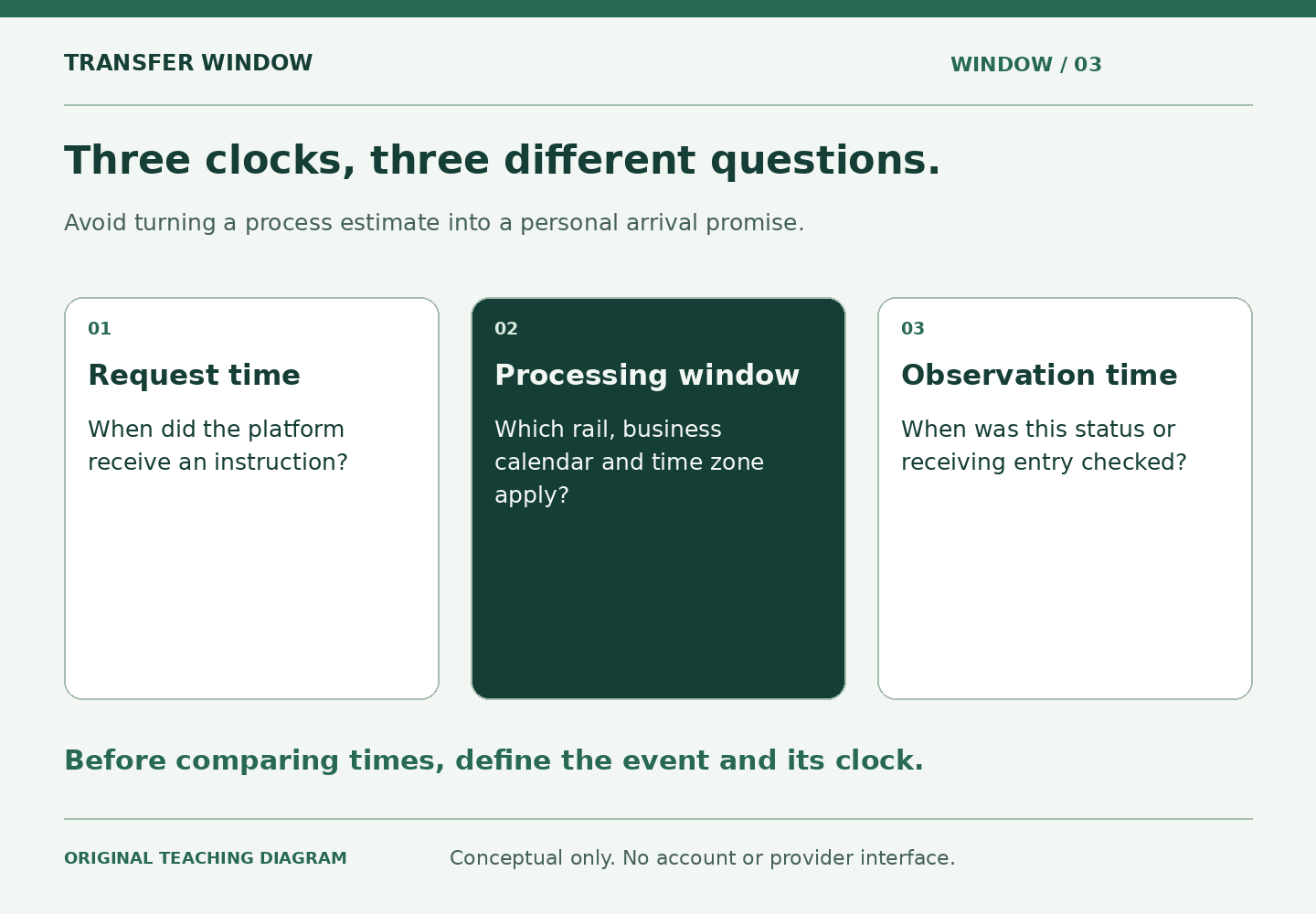
Counting days sounds simple until a payment crosses a weekend, a holiday, a cutoff, and two time zones. The arithmetic is rarely the only source of confusion. More often, people start counting from different events or apply a range to the wrong stage. A business-day worksheet can make those assumptions visible. It cannot replace the timing information supplied for a particular transfer, and it should never be presented as a guaranteed delivery-date calculator.
Identify what starts the clock
Before marking a calendar, write the event that the estimate uses as its starting point. Is it request creation, acceptance, export, or a later processing event? If the source does not say, that ambiguity should stay visible. Choosing the earliest timestamp simply because it is available can make a payment appear overdue before the relevant timing window has even been established.
Dwolla’s published processing guide describes standard ACH on business days, excluding weekends and banking holidays. It gives different standard debit and credit ranges. These are product-level descriptions, not evidence that a specific payment entered a particular processing window.
Keep calendar days and counted days separate
Use two columns in a scratch worksheet: actual date and counted business-day position. A weekend date can remain visible while receiving no counted position under the applicable business-day convention. This is clearer than deleting the weekend entirely, because people still experience the elapsed calendar time even when the processing description uses another measure.
For an invented example with no holiday, suppose the first eligible day in a stated counting method is Monday. Tuesday is the next counted day and Wednesday follows it. If someone instead calls Monday “day zero,” the numerical labels shift even though the dates do not. Always explain the convention instead of arguing over a bare phrase such as “day three.”
Make the cutoff assumption explicit
A request made in the afternoon may sit close to a relevant cutoff, but a clock reading alone does not prove how it was handled. The safe worksheet entry is the known submission time plus the unresolved processing-window question. Avoid drawing a sharp boundary in your own notes that is more certain than the provider’s published qualification.
Time zones add another layer. “Four o’clock” is incomplete without a zone, and a person traveling may be looking at a different local clock than the system uses. Preserve the original timestamp and its zone. If you convert it, label the converted value so that a later reader does not mistake it for an independently recorded event.
Test the holiday assumption
A fictional customer submits a request late Friday and expects movement on Monday. Before deciding that Monday is a counted processing day, the worksheet needs the applicable holiday calendar. Do not use a generic office calendar or assume every day your own business is open is a banking processing day. The relevant calendar is part of the estimate’s definition.
When the exact calendar is unknown, write “holiday treatment not confirmed.” That phrase is more useful than silently adding or subtracting a day. It identifies a precise question for the provider and keeps an illustrative calculation from becoming a customer-facing promise. The calendar is an input, not a fact that can be inferred from impatience.
Do not add unlike ranges casually
A range for one stage cannot automatically stand in for the end-to-end journey. Equally, adding every number found on several documentation pages may produce a total that corresponds to no actual workflow. First establish which stages apply, which depend on earlier stages, and what each published range measures.
The payment timeline method can help separate those components. If a faster payment option is mentioned, treat it as a separate eligibility and routing question. Do not shorten an ACH worksheet merely because an instant-payment feature exists somewhere in the product family. Availability of a feature and selection for a specific payment are different propositions.
Communicate a range with its assumptions
A responsible calendar note might read: “This illustration counts eligible business days after the assumed starting event; actual processing placement and holiday treatment remain unconfirmed.” The language may feel less satisfying than a bold date, but it is honest about what the calculation can support. For an actual payment, use the provider’s applicable current information.
Keep the worksheet compact enough to revise when new evidence arrives. Record the starting event, calendar basis, time zone, relevant stage, and source of the estimate. If any input changes, revisit the conclusion. Good day counting is not about producing the earliest plausible date. It is about preventing a hidden assumption from becoming the basis of someone else’s plans.