In this article
Distinguish a supported payment network from availability for a particular account, route, and transfer.
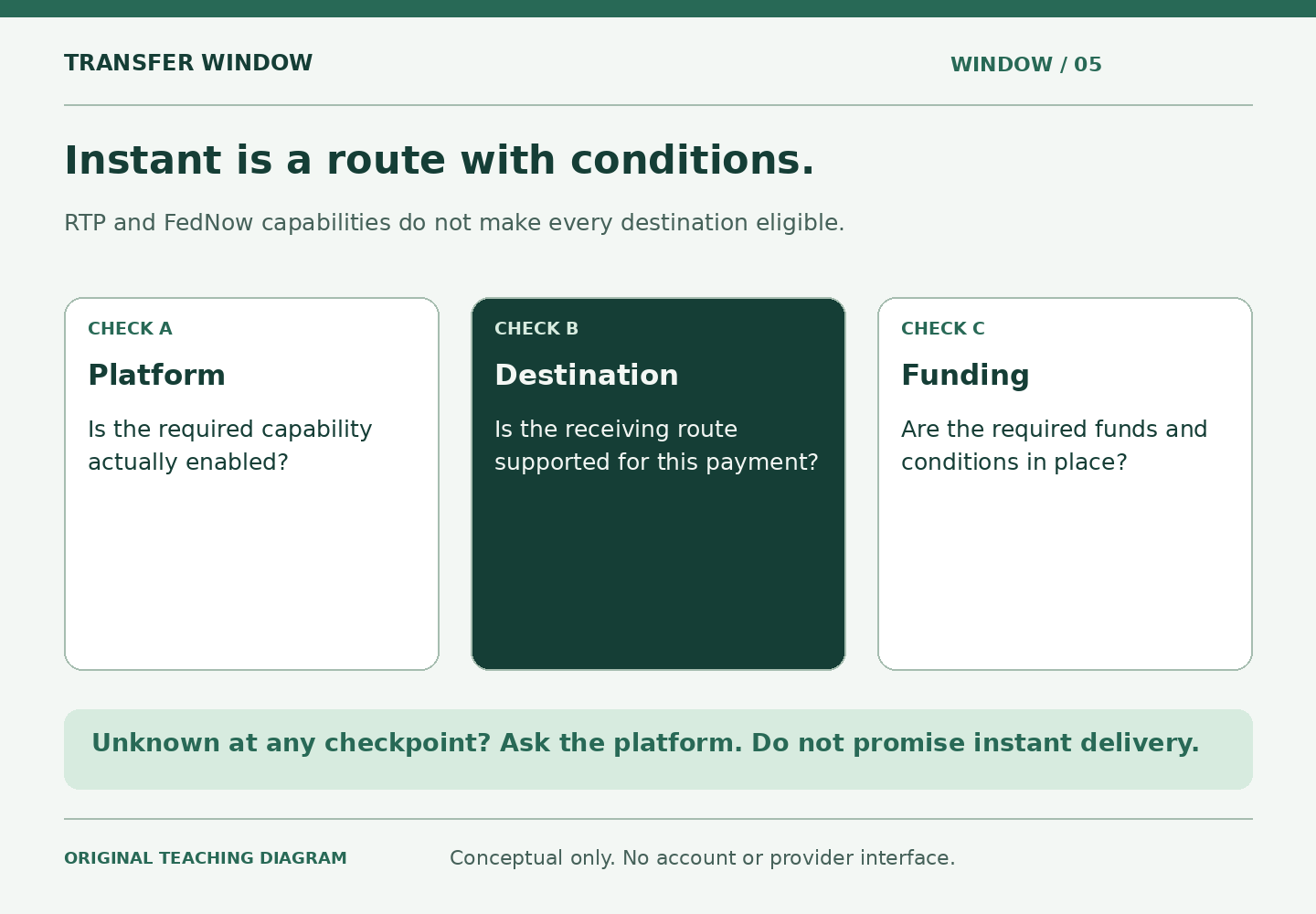
“Instant” is a powerful word because it sounds like an answer to every timing question. In practice, the useful question is narrower: does this particular payment qualify for the relevant instant route, and what evidence confirms that route was used? A product offering can include fast capabilities without making every payment eligible. This article offers a question framework for evaluating a claim, not a comparison of prices or a promise about any transfer’s arrival.
Question one: which payment option is meant?
Dwolla’s Instant Payments documentation covers RTP and FedNow. It describes a premium feature requiring additional approval, eligible destinations, and credit-push payments funded from an available Dwolla balance. These conditions matter: the existence of the feature is not proof that every customer, account, or movement can use it.
When someone says “instant,” ask whether they mean that documented option, an application’s marketing phrase, a quick internal acknowledgment, or a different service entirely. The same adjective can describe several experiences. A receipt appearing immediately is not, by itself, evidence about the payment network used for the underlying movement.
Question two: available to whom?
Separate product capability from customer availability. An organization may have seen a feature announcement without having the applicable feature enabled. A recipient may use a bank associated with an available network while the particular destination still requires an eligibility check. These are questions to establish, not facts to infer from a familiar bank name.
A useful comparison note has separate fields for the provider’s general offering and the evidence specific to the proposed payment. Keep an empty field empty when you do not have confirmation. A conditional answer is more informative than a confident “yes” built by combining several broad statements that were never about the same case.
Question three: which part of the journey?
A fast outgoing movement does not logically prove that every prerequisite happened instantly. In a fictional example, a marketplace plans a payout but has not yet established whether the necessary funds are available for the intended route. Advertising a short final movement would not answer the earlier readiness question.
Map the prerequisites separately from the outward payment. The stage-mapping guide provides a general method. Do not imply that an earlier ACH movement becomes instant merely because a later stage could use another option. The end-to-end experience depends on the actual sequence and the evidence for each part.
Question four: what happens if the route is unavailable?
A proposed fallback needs its own explanation. If the intended option cannot be used, will the application stop, offer another choice, or follow an already agreed process? Do not assume a fallback exists, and do not assume its timing or cost matches the original option. Those details require the applicable provider and product information.
For planning, write two scenarios: “intended route confirmed” and “intended route not confirmed.” The second should identify a decision owner, not invent a substitute payment. This is especially important when a recipient is planning around a promised date. A fallback chosen without a clear conversation can change the practical meaning of the original promise.
Question five: what confirms the outcome?
The most useful final evidence is specific to the payment, rather than another copy of the product description. A general capability page can establish what the provider offers; it cannot establish what happened to a transaction it does not identify. Preserve the observed record, timestamp, and relevant reference when documenting an outcome.
Treat any unresolved outcome as unresolved even if the intended route is fast. Speed is not a substitute for identification. If the reference is wrong, an immediate-looking update about another payment will still produce an incorrect answer. The same evidence discipline used for slower payments remains valuable here.
Write the claim at the right level
A responsible planning sentence might say, “An instant-payment option may be available if the applicable approvals, funding, and destination conditions are met.” Once the specific facts are known, the wording can become more specific. Until then, keep the conditions next to the claim rather than relegating them to a distant disclaimer.
For a mixed-method workflow, maintain separate timing assumptions instead of applying one calendar to every movement. The ACH calendar article addresses one such distinction. Good eligibility questions do not make an offering sound less capable. They make clear which capability has actually been established for the payment someone cares about.