In this article
Use a stage-by-stage sketch to keep one completed movement from standing in for an entire payment.
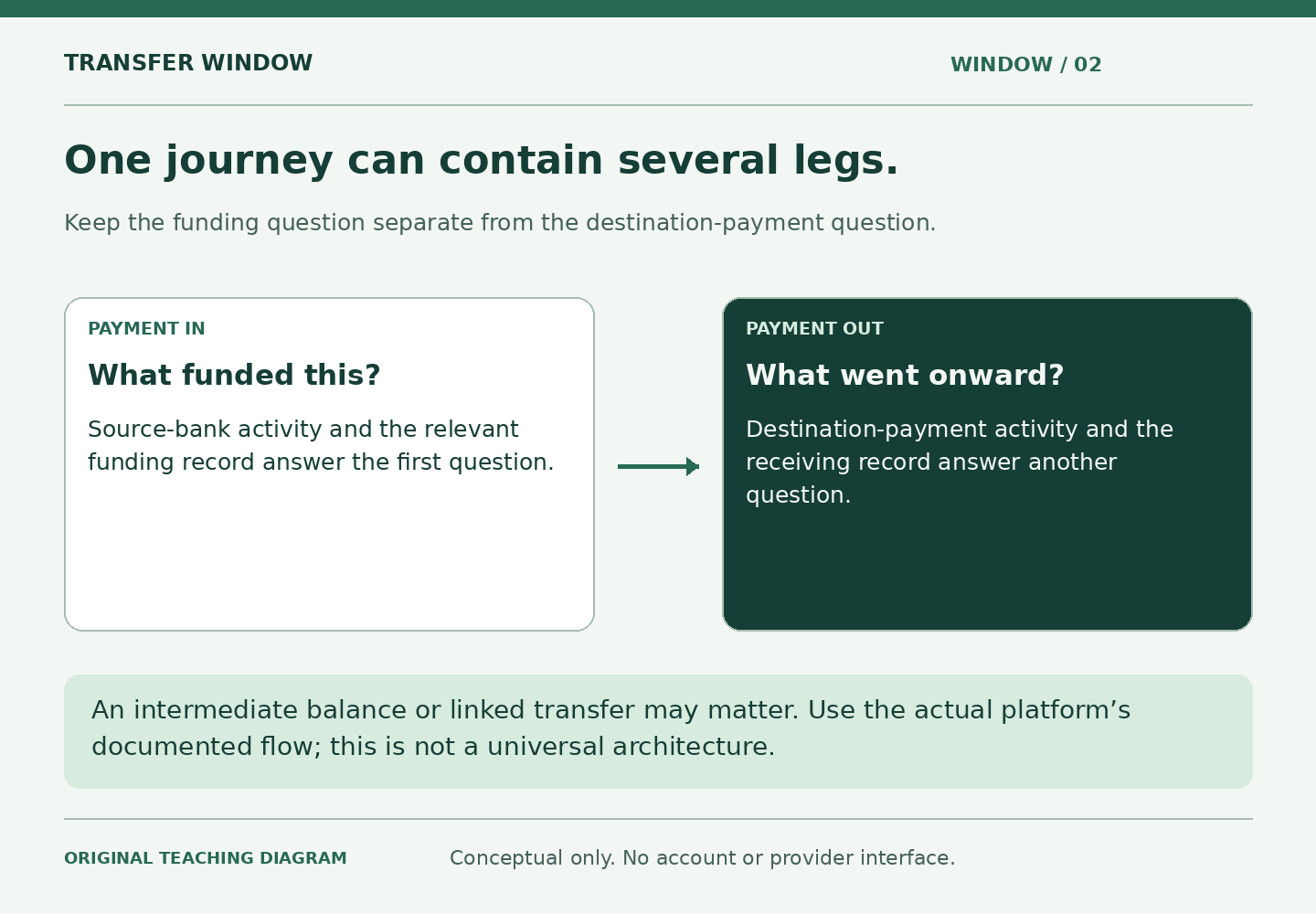
A commercial payment usually has a simple purpose: one party owes another money. Its records can be less simple. An invoice, a payment instruction, and several movement records may all describe parts of the same business event. Trouble starts when a person assumes that every record is a complete picture. Drawing a small map of the relevant stages helps explain why a positive update about one movement may leave another question unanswered.
Separate the business purpose from the movement
Begin with the purpose in everyday words, such as “Studio pays editor for September work.” Then leave space underneath for the movement records associated with it. The business purpose is the organizing label, not proof of how money traveled. You should be able to revise the movement map without rewriting the invoice description.
Dwolla’s lifecycle guide describes account-to-account transfers as connected legs and explains links between funding and funded transfers. This article uses that limited concept as a starting point for an independent paper worksheet. It does not prescribe one identical route for every customer or payment configuration.
Give each stage its own row
For every known stage, record its source role, destination role, reference, status, and observation time. Use generic roles such as “origin bank” or “destination bank” in a shared illustration. Do not add an intermediate stage merely because another example included one. Unknown routing should remain unknown until the provider’s information establishes it.
Rows make missing evidence easier to notice. If one stage has a status and the next has only an expectation, the difference stays visible. A single large arrow labeled “paid” would erase that distinction. The map should be as detailed as the evidence supports, without pretending that every blank can be filled from general documentation.
Ask which stage a sentence describes
In an invented case, a publisher’s operations note says, “Funding completed.” A colleague forwards that as, “The illustrator has been paid.” The second sentence adds a conclusion about the recipient that the first sentence did not contain. On a stage map, this leap is obvious: a note about an earlier movement has been attached to the final destination.
A better update keeps the subject intact: “The funding stage is reported complete; we are checking the destination stage.” This wording does not imply that a problem exists. It reflects the difference between evidence of progress and evidence answering the recipient’s actual question. See reading a transfer status for a related approach to preserving the subject of a label.
Treat amounts as identifiers with limits
Matching dollar amounts can help identify candidate records, but amount alone is weak evidence. Two invoices can have the same value, and a business can make several similar payments on the same day. Keep the business reference and movement reference alongside the amount rather than matching solely on a number that happens to look familiar.
If values differ, do not invent a fee explanation or assume money disappeared. Record the mismatch as a question. It might concern different records, a separate adjustment, or some other fact that the available evidence does not establish. The map is useful because it stops a plausible story from being mistaken for a verified explanation.
Draw dependencies without predicting them
An arrow between stages should mean something specific. It may indicate the relationship shown in a provider record or an explicitly documented prerequisite. It should not mean “this must happen next at this hour” unless the evidence actually says so. A dependency is a relationship; a schedule is a timing claim. Combining them carelessly gives the diagram false precision.
One useful annotation is “relationship confirmed, timing unconfirmed.” Another is “candidate related record, not yet matched.” These labels may seem cautious, but they let another reviewer see exactly what remains to be established. A good diagram supports questions as well as conclusions.
Close the commercial question separately
After the movement map is understood, return to the original business purpose. What evidence is needed to close that purpose in the organization’s own process? An invoice marked settled, a recipient acknowledgment, and a provider status are different kinds of records. The applicable accounting or operational policy determines how they should be used; this educational sketch does not replace that policy.
Keep the final summary proportional to the evidence: which movements were identified, which statuses were observed, and which question remains open. If the next step is matching records across sources, use the reconciliation guide. The reward for mapping stages is not a more elaborate diagram. It is a smaller chance of answering a whole-payment question with evidence about only one part.