In this article
Separate a recorded status, the payment stage it describes, and the evidence still missing.
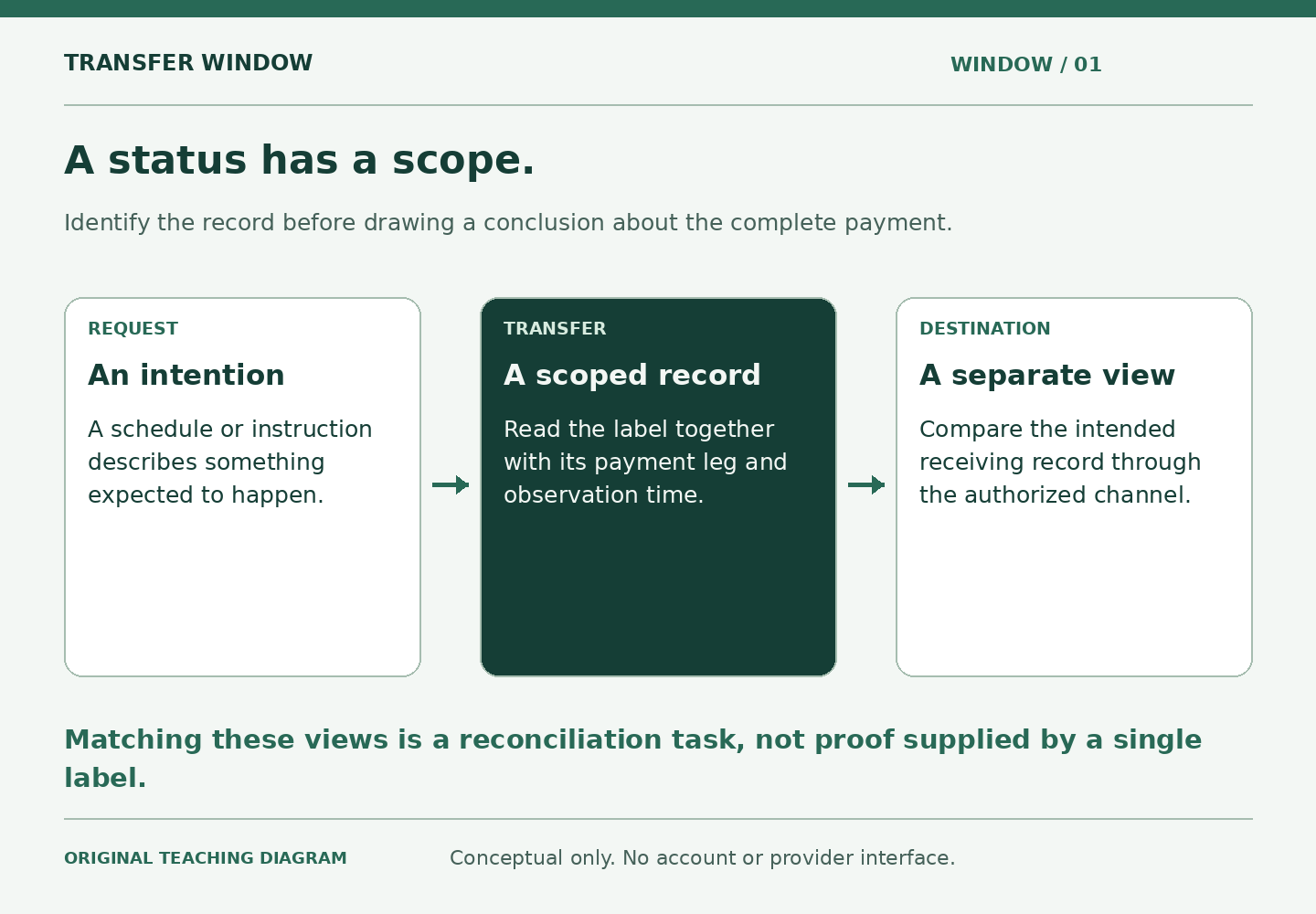
A payment status is a short label carrying a surprisingly large burden. Someone waiting for money may read it as a promise; someone reviewing a record may read it as an operational checkpoint. Those interpretations can diverge even when both people see the same word. A more useful reading begins with three questions: what record is this, when was it checked, and what does the label actually establish? This article offers a method for interpreting evidence, not a determination about any particular payment.
Start with the exact label
Dwolla’s Transfer Lifecycle documentation lists pending, processed, cancelled, and failed. It explains that processed has a destination-dependent meaning: wallet clearing and bank-destination timing are described differently. That distinction is a reason to preserve the original wording rather than translate every positive-looking label into “the recipient has the money.”
Write the label as displayed, including its spelling. Then note where it appeared: a payment application, a support response, or a technical record. These are observations with different scopes. A message saying that a request was accepted describes a request. A statement describing a bank entry describes a bank entry. Neither sentence should quietly become a broader claim merely because a reader expects the whole journey to be complete.
Give the status a subject
Try completing this sentence: “This status describes ______.” If you cannot fill in the blank, you do not yet have enough context to interpret the label confidently. The blank might be a specific transfer record, a payout request, a verification step, or a larger order. All can exist around one commercial transaction, but their progress does not have to be identical.
In a fictional example, a design studio sees “complete” next to invoice approval and assumes its contractor’s payment is complete. The label is real, but its subject is the approval workflow. The mistake is grammatical as much as technical: the reader supplied a different noun. Adding the subject makes the misunderstanding visible before anyone sends a confident but unsupported update.
Separate observation from conclusion
A useful note has two lines. The first says what was observed, such as “The application displayed pending at 10:15 a.m. Eastern.” The second says what remains unknown, such as “The destination posting has not been confirmed.” This separation keeps a missing fact from being turned into a negative fact. “Not confirmed” does not mean “did not happen,” just as “no failure notice seen” does not prove success.
The distinction is especially helpful when several people are working on the same question. One person may have a fresh application view while another has an older email. If both describe their observation as the present truth without a timestamp, the team can appear to disagree when it is actually comparing different moments.
Preserve the time of the check
Record the observation time separately from any creation time shown in the record. A transfer could have been created yesterday while the screenshot was captured this morning. Those timestamps answer different questions. Include the time zone when a particular hour matters, and avoid interpreting a date-only label as if it includes a precise hour.
A simple status journal can be short: reference, exact label, observed time, evidence source, open question. Keep sensitive identifiers out of shared notes. A masked reference or internally assigned case label is usually enough for a discussion document. The goal is traceability, not collecting every detail that happens to be visible on a screen.
Resist the urge to translate uncertainty away
Consider two fictional updates: “It is done” and “The transfer record shows processed; recipient-side confirmation is still outstanding.” The second is longer, but it exposes the remaining question. It does not claim that something is wrong. It simply prevents one observation from standing in for another.
This approach also helps with uncomfortable labels. Do not soften an actual failure into “a little delayed,” or turn a pending label into “stuck” without supporting evidence. Neutral language preserves options. The payment status message guide shows how to write a concise update that includes uncertainty without sounding evasive.
End with the next evidence needed
An interpretation is useful when it points to a specific unresolved fact. Is the missing piece the identity of the record, the latest update, the destination, or the applicable timing basis? Choose one question before collecting more screenshots. A focused question is easier for the payment provider to answer than a general request to explain everything.
If the record is only one stage of a larger movement, use the transfer-leg worksheet to map the rest. If the label remains pending, use a structured checklist rather than repeatedly refreshing. Better status reading does not accelerate a payment; it reduces avoidable misunderstanding about where the evidence ends.